REP Fitness
REP rubber floor tiles, 3/8 in, set of 4 (16 sq ft)
$69.99 (set of 4)Checked Oct 8, 2026
Check pricesOpens REP Fitness's site. Not a referral link.
Free to read. No paid listings. How we make money
Guide: flooring and floor load
How thick a mat needs to be for what you drop, why foam belongs under stretching and not under a barbell, and what a loaded rack weighs per square foot next to the 30 and 40 psf the residential code table designs floors for. Merchant numbers read October 8, 2026; the arithmetic is ours.
Washington State Register filing of IRC Table R301.5; Rogue, American Barbell pages, Oct 8, 2026; our arithmetic. See source
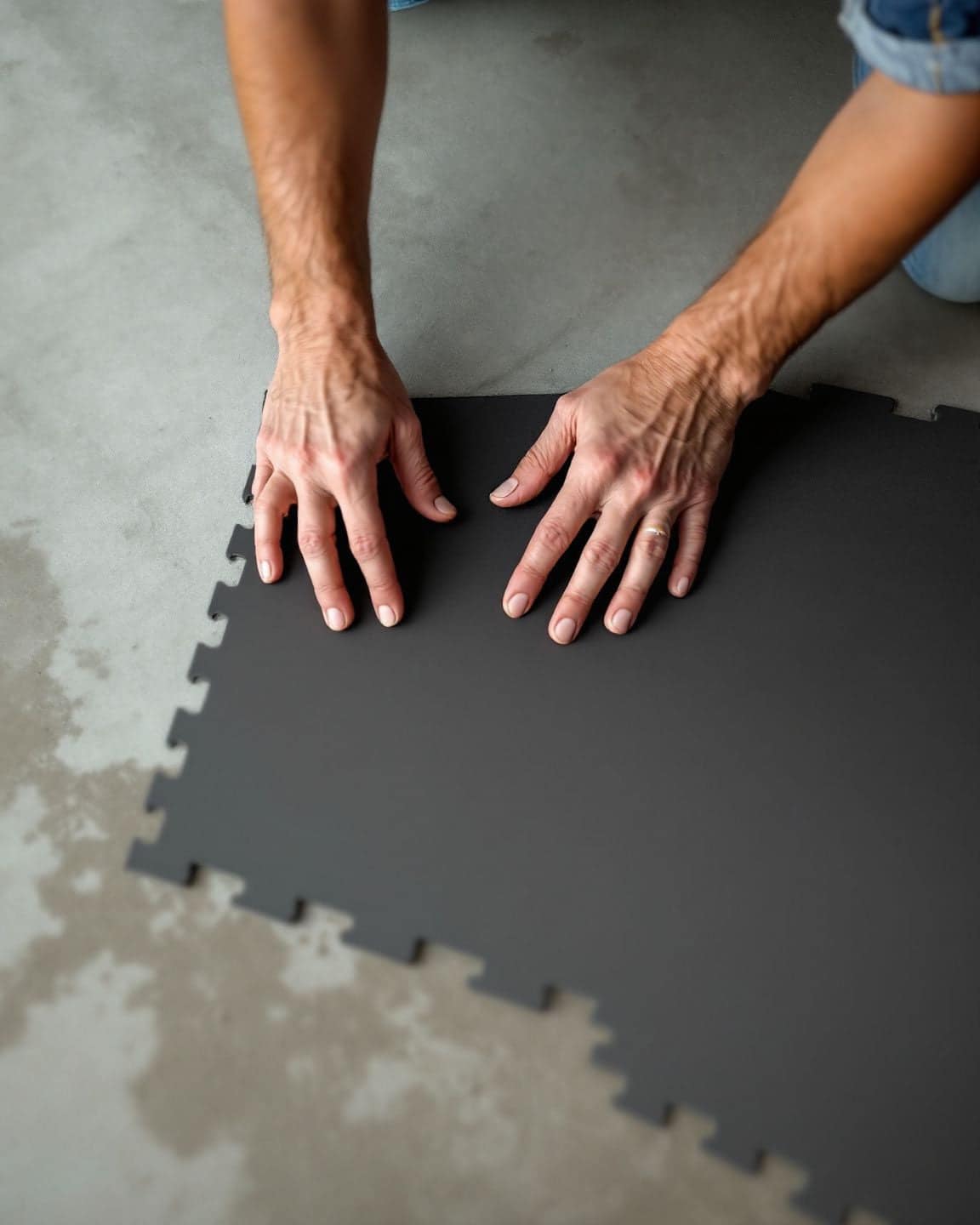
REP Fitness
$69.99 (set of 4)Checked Oct 8, 2026
Titan Fitness
$299.97 (regular $379.99)Checked Oct 8, 2026
Rogue Fitness
$85.00 shown with the pair selectedChecked Oct 8, 2026
Residential floors in the United States are designed to the International Residential Code's Table R301.5, 'Minimum uniformly distributed live loads (in pounds per square foot)'. The table as adopted in Washington State's rule reads 40 psf for rooms other than sleeping rooms, 30 psf for sleeping rooms, 40 for stairs and 50 for passenger vehicle garages1. A live load is the people and movable things a floor must carry on top of its own weight; 'uniformly distributed' means the number is an average over the whole area of the room, which is how a bedroom full of furniture and people behaves.
A barbell gym does not behave that way. A rack stands on four small feet, plates stack in one corner, and a deadlift puts the whole bar's weight on two plate edges at the instant it lands. The table cannot tell you a floor is fine; it tells you what the floor was designed to average, and it says nothing about a point load, a dropped bar or an older house built to a different edition of the code. A concrete slab on grade, the usual garage and basement floor, is a different case from a framed floor over a room below. For an upstairs gym, ask a structural engineer and bring the numbers below; that is a professional's call, not ours.
Equipment weights from each maker's page on October 8, 2026. The lifter's weight is our assumption. Pounds per square foot divides the total by the rack's published footprint, which is the most favourable way to spread it; the real load sits on the feet.
| Scenario | Items and published weights | Total (ours) | Footprint | psf over the footprint (ours) |
|---|---|---|---|---|
| Rogue R-3 with a 20 kg bar, two 55 lb pairs and a 200 lb lifter9 | Rack 200 lb; bar 20 kg, about 44 lb; plates 220 lb; lifter 200 lb | 664 lb | 53 x 34 in, 12.5 sq ft | About 53 psf |
| Titan T-3 91 in, same bar, plates and lifter10 | Rack 196 lb; bar about 44 lb; plates 220 lb; lifter 200 lb | 660 lb | 54 x 32.75 in, 12.3 sq ft | About 54 psf |
| REP PR-1100, same bar, plates and lifter8 | Rack 130 lb; bar about 44 lb; plates 220 lb; lifter 200 lb | 594 lb | 58.1 x 48.5 in, 19.6 sq ft | About 30 psf |
| Concept2 RowErg with a 200 lb user12 | Machine 57 lb (standard legs); user 200 lb | 257 lb | 96 x 24 in, 16 sq ft | About 16 psf |
| Concept2 BikeErg with a 200 lb user13 | Machine 68 lb; user 200 lb | 268 lb | 48 x 24 in, 8 sq ft | About 34 psf |
| A 4 x 8 ft platform of Rogue 1.5 in tiles, empty2 | 8 tiles at 28 lb | 224 lb | 32 sq ft | 7 psf of mat alone |
| Source | Maker product pagesRead Oct 8, 2026 | Our arithmeticRead Oct 8, 2026 | Maker spec tablesRead Oct 8, 2026 | Our arithmeticRead Oct 8, 2026 |
The 20 kg bar's 44 lb is our conversion (20 x 2.2046); American Barbell's California Bar is sold in 15 and 20 kg11. 220 lb of plates is two of American Barbell's 55 lb Sport pairs11. Divide by the footprint and a 200 lb rack looks modest; put the same 664 lb on four 3 x 3 in feet and each foot carries about 166 lb on 9 sq in, which is why a mat under the feet and a slab under the mat are the normal answer.
Each maker's own figures. Price per square foot is ours (price divided by the coverage the maker states).
| Mat | Thickness | Weight and coverage | Listed price | Per sq ft (ours) |
|---|---|---|---|---|
| Titan black rubber flooring roll, 15 x 4 ft5Check pricesOpens Titan Fitness's site. Not a referral link. | 8 mm (0.315 in) | 100 lb; 60 sq ft | $299.97 (regular $379.99) | $5.00 |
| REP rubber floor tiles, set of 43Check pricesOpens REP Fitness's site. Not a referral link. | 3/8 in | 24 x 24 in tiles; 16 sq ft per set | $69.99 | $4.37 |
| Titan interlocking rubber tiles, 12 pack6Check pricesOpens Titan Fitness's site. Not a referral link. | 10 mm (0.393 in) | 5 lb each, 60 lb a pack; 19.685 in square, about 32 sq ft (ours) | $154.97 (regular $189.99) | About $4.80 |
| REP rubber-topped foam tiles, set of 44Check pricesOpens REP Fitness's site. Not a referral link. | 1/2 or 3/4 in | About 3 lb each; 16 sq ft per set | $54.99 with 3/4 in selected | $3.44 |
| Rogue Rubber Tile 24 x 24 x 1.5 in2Check pricesOpens Rogue Fitness's site. Not a referral link. | 1.5 in | 28 lb each; 4 sq ft each | $85.00 shown with the pair selected | $10.63 if the $85.00 is the pair |
| Titan rubber lifting tiles, 2 pack7Check pricesOpens Titan Fitness's site. Not a referral link. | 1.6 in | 28 lb each; 8 sq ft per pack | $99.97 (regular $109.99) | $12.50 |
| Source | Maker product pagesRead Oct 8, 2026 | Maker product pagesRead Oct 8, 2026 | Maker product pagesRead Oct 8, 2026 | Our arithmeticRead Oct 8, 2026 |
Titan's 12-pack tiles are 19.685 in square, 2.69 sq ft each by our arithmetic; Titan says they are centre tiles and corners need trimming. Rogue's page showed $85.00 with 'Pair' as the selected pack size; confirm on the page before dividing by two. Titan says its lifting tiles are only compatible with its own platforms.
Nothing dropped: 3/8 in or 8 mm rubber. REP sells its 3/8 in tiles as protection for 'both your floor and equipment' that will 'reduce noise and won't absorb moisture'3; Titan sells its 8 mm roll for 'reducing noise, vibrations, and impacts' with a 'slip-resistant' surface5. For a rack where the bar is set down on J-cups and safeties, and for machines, this is the layer under the feet; the rolled 60 sq ft is the cheapest way to cover a whole bay at $5.00 a square foot by our arithmetic.
Plates set down hard: 10 mm and up. Titan's 10 mm interlocking tiles are 'engineered to reduce noise, vibration, and impact'6. The step up in thickness buys a margin for deadlifts that land rather than get lowered; the trade is trimming the puzzle edges at walls, which Titan says the centre-only pack needs6.
Dropped from the hip or overhead: platform tiles. Rogue sells its 1.5 in tile 'to build a lifting platform' and 'as a landing pad for atlas stones', with eight tiles making a 4 x 8 ft platform2; Titan's 1.6 in tile is sold to protect 'your floor and plates from damage after being dropped', on its own platform frames7. Both weigh 28 lb a tile, so a platform is its own 200 lb object before anything lands on it27.
Foam is for the body, not the bar. REP describes its foam tiles as a hard rubber top over an EVA foam bottom that is 'soft on your joints during floor exercises', about 3 lb a tile4. That is the stretching and bodyweight corner. A rack foot or a dropped plate on foam compresses it unevenly, and none of the makers above sells foam for that job.
A garage slab is a passenger vehicle garage in the table's terms, designed to 50 psf1, and a concrete slab on grade bears on the ground beneath it rather than on joists. That is why most garage gyms need nothing more than a mat to protect the concrete and quiet the room. A basement slab is the same case; the questions there are moisture and the ceiling, not the floor's strength, and our ceiling guide covers the second.
An upstairs room is a framed floor over another room, designed to 30 psf as a sleeping room or 40 psf otherwise1. The example above spreads a loaded rack to 53 psf over the rack's own footprint and then concentrates it on four feet; a dropped deadlift adds a shock no static table measures. Nobody should take a number from this page as permission. Take the equipment weights and the planned footprint to a structural engineer, and plan a 3/8 in rubber layer plus a wider plywood or platform base under the rack feet so the engineer has a load path to approve. A lighter frame helps the arithmetic: REP's PR-1100 is 130 lb on 19.6 sq ft against Rogue's 200 lb on 12.589.
Step 1
Slab on grade (garage, most basements) or framed floor (upstairs, over a crawlspace). Only the second needs the engineer.
Step 2
Rack weight from the maker's spec table, bar, every plate you own, and you. Our table above shows the pattern: 600 to 660 lb for a rack-and-plates setup.
Step 4
A 4 x 8 ft platform is 8 Rogue tiles or two REP sets; the rest of the room can be the cheaper roll. Whole-room totals are in the cost guide.
Each page has the price of the day, pack sizes and the maker's installation notes. Plain links; the brand has no account with any of them.
Good for covering a whole bay with one 60 sq ft roll
Also on Titan Fitness's site
Good for a 4 x 8 ft platform from eight tiles
Good for a 16 sq ft rack zone at $69.99, or a foam stretching corner
Also on REP Fitness's site
By what you drop. 3/8 in or 8 mm rubber is sold for floor and equipment protection under a rack and machines35; 10 mm for landing deadlifts6; 1.5 to 1.6 in platform tiles for bars dropped from the hip or overhead27. Foam is sold for floor exercises4.
This page cannot answer that, and neither can the code table. Table R301.5 designs sleeping rooms to 30 psf and other rooms to 40 psf as evenly spread loads1; our example rack-and-plates setup is about 53 psf over the rack's footprint and sits on four feet. Take the maker's weights to a structural engineer.
The roll covers 60 sq ft for $299.97 with straight edges and weighs 100 lb5; tiles interlock and let you cover an odd shape, with trimming at walls on Titan's centre-only pack6. REP's 3/8 in tiles are $69.99 for 16 sq ft3. Per square foot by our arithmetic: roll $5.00, REP tiles $4.37, Titan tiles about $4.80.
A rubber mat protects the slab and quiets the drop; it does not change what the house carries, and it adds weight of its own, 7 psf for a Rogue 1.5 in tile by our arithmetic2. For a framed floor, the load path the engineer approves usually includes a rigid base wider than the rack feet; the mat goes on top of that.
Prices, dimensions and shipping belong to each merchant and can change. The merchant's own page is the final word on price, availability and terms.
GymFloor Planner compares published dimensions. We have not installed or lifted on this equipment; measure your own room and follow the maker's installation instructions.